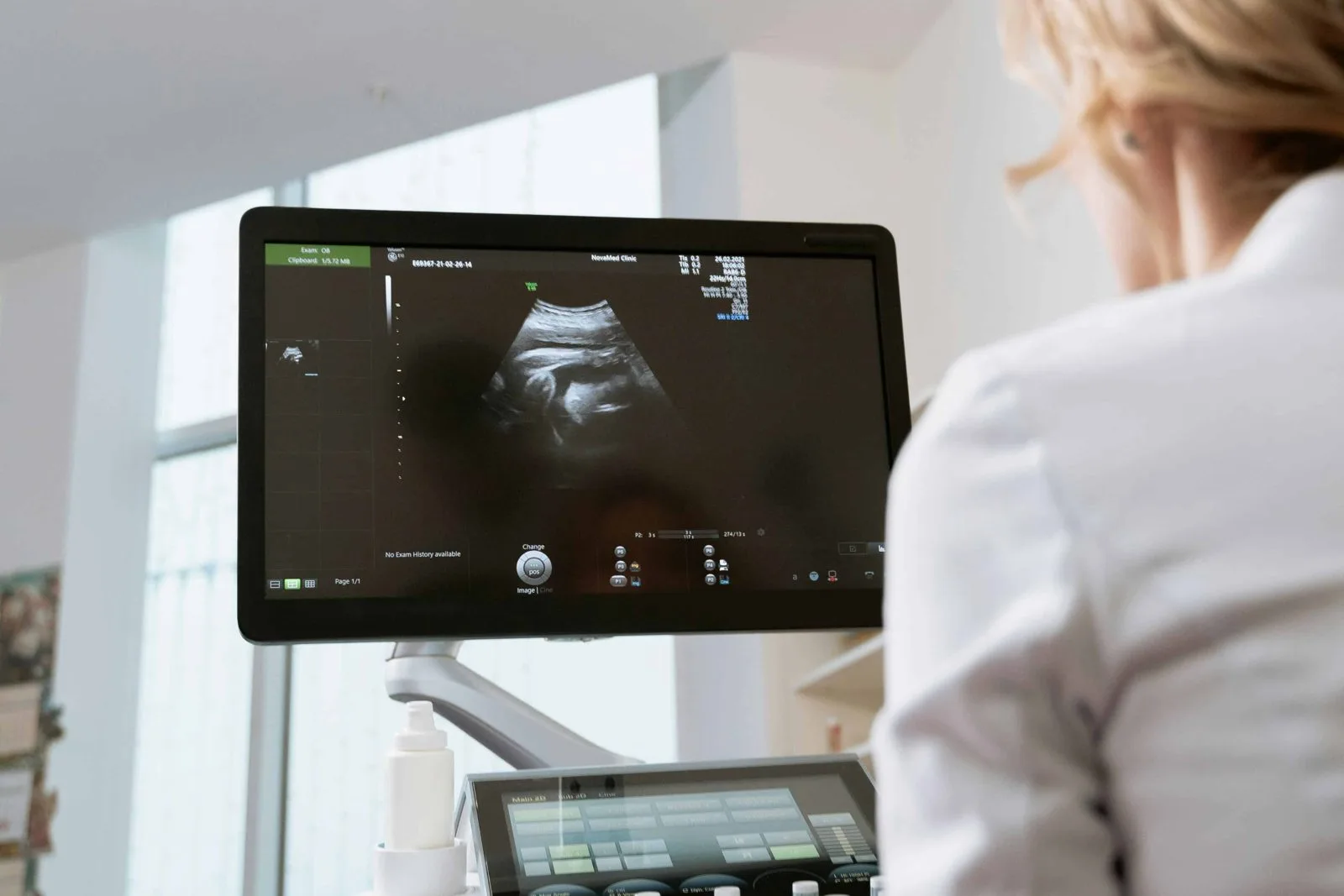
What ultrasound is used for
Ultrasound uses sound waves, not radiation, to image organs, soft tissue and blood flow in real time. It is safe to repeat, needs no contrast for most exams, and is the first-line test for many abdominal, pelvic, thyroid and vascular questions. Your provider chooses the exam; the sections below explain what each one involves and how to prepare.
Abdominal ultrasound
Images the liver, gallbladder, bile ducts, pancreas, spleen, kidneys and the aorta. Commonly ordered for pain in the upper abdomen, abnormal liver tests, suspected gallstones, kidney stones or cysts, and to follow known findings. Preparation: nothing to eat or drink for 6 to 8 hours before the scan so the gallbladder is full and bowel gas is reduced; take usual medications with a sip of water. Allow about 30 minutes.
Pelvic and bladder ultrasound
Images the uterus, ovaries and bladder, or the prostate and bladder. Ordered for pelvic pain, abnormal bleeding, fibroids, ovarian cysts, urinary symptoms and to measure how well the bladder empties. Preparation: a full bladder. Finish about three to four glasses of water an hour before your appointment and do not empty your bladder until the scan is done. If your provider has requested a transvaginal view, the sonographer explains it before proceeding and you may decline. Allow 30 to 45 minutes.
Thyroid and neck ultrasound
Images the thyroid gland, nearby lymph nodes and salivary glands. Ordered for a lump in the neck, abnormal thyroid blood tests, or to follow thyroid nodules over time. No preparation; avoid necklaces and high collars. Allow about 20 minutes. If a nodule needs a biopsy, that is arranged by your provider at a hospital or specialist clinic.
Breast ultrasound
Images a specific area of the breast, often to look more closely at a lump felt on examination or a finding on a mammogram, and in younger patients where mammography is less useful. No preparation; avoid lotion or powder on the chest that day. Allow about 20 to 30 minutes. Breast ultrasound at Bio-Test is diagnostic, ordered for a specific concern; routine screening mammography is arranged through the Ontario Breast Screening Program.
Soft-tissue and musculoskeletal ultrasound
Images a lump under the skin, a swollen joint or tendon, or a suspected hernia. Ordered to tell a fluid-filled cyst from a solid lump, to look at tendons such as the rotator cuff or Achilles, and to check groin or abdominal-wall hernias. No preparation. Allow about 20 to 30 minutes; the sonographer may ask you to move the joint during the scan.
Vascular (Doppler) ultrasound
Measures blood flow through arteries and veins. Ordered for a swollen or painful leg where a clot is suspected, for narrowing of the carotid arteries in the neck, for varicose veins, and to check circulation in the legs. No preparation for most vascular exams; wear loose clothing. Allow 30 to 45 minutes. If your provider suspects a clot, they will tell you how urgently the scan is needed; for sudden severe leg swelling with chest pain or breathlessness go to an emergency department.
Scans we refer on
Obstetric (pregnancy) scans, paediatric exams and specialised studies such as echocardiograms are directed by your provider to the appropriate hospital or imaging service. Keepsake pregnancy imaging without a medical indication is not offered.
You need a requisition
Ultrasound requires a referral that states the body area and the clinical question. Bio-Test cannot perform a scan without it, and the sonographer follows the requisition exactly. If your provider faxes the requisition, tell us when you call.
How to book
- Call 613-789-4242 or 1-800-409-1942 (toll-free) during business hours; weekend appointment times are available.
- Have your Ontario health card number and the requisition in front of you.
- Ask which exam is being booked and what preparation applies; instructions differ by body area.
- Arrive 10 minutes early to register; allow 20 to 45 minutes for most exams.
Is ultrasound covered by OHIP?
Yes. Diagnostic ultrasound ordered by an authorized provider is insured with a valid Ontario health card. Scans requested without a medical indication, such as keepsake obstetric imaging, are not offered.
What to bring to your ultrasound appointment
- Your valid Ontario health card; without it the exam is uninsured until the card is renewed.
- The ultrasound requisition from your provider, unless it was faxed to us (tell us at booking).
- Any previous imaging reports for the same area, if you have them, so the radiologist can compare.
- A list of current medications if the requisition asks for it.
What happens during the exam
You register at the Bells Corners desk about 10 minutes before your appointment. The sonographer confirms your identity and the requisition, explains the exam, and asks you to uncover the area being scanned; for some exams you change into a gown. Warm gel is applied to the skin and a hand-held transducer is moved over the area while images are recorded. You may be asked to hold your breath or change position. The gel wipes off and you can return to normal activities immediately.
Getting your results
The images are interpreted by a radiologist and the report is sent to your ordering provider, who reviews it with you. Allow several business days. The sonographer cannot discuss findings during the exam. If something needs prompt attention, the radiologist contacts your provider directly.
Same-visit bloodwork and imaging
Bells Corners is Bio-Test's main laboratory and offers walk-in blood collection Monday to Friday 7:30 am to 8:00 pm and Saturday 8:30 am to 2:00 pm, plus walk-in X-ray and ECG. Ultrasound is the one imaging service that must be booked by phone. If you have a lab requisition too, bring it to your ultrasound appointment and have everything done in one trip. See the Bells Corners location page for directions and free parking; our other centres can direct you here for ultrasound. Preparing for a blood test the same day? Our preparation guide explains fasting rules.